Showing posts with label history. Show all posts

Monday, August 20, 2007

The Great Flood at Chek Jawa

NF#1: In January 2007, Singapore experience some of the heaviest rainfall in 75 years. The rain was just as severe in Johor, and the Johor River was bloated with rain water, which it eventually released into the Straits of Johor.


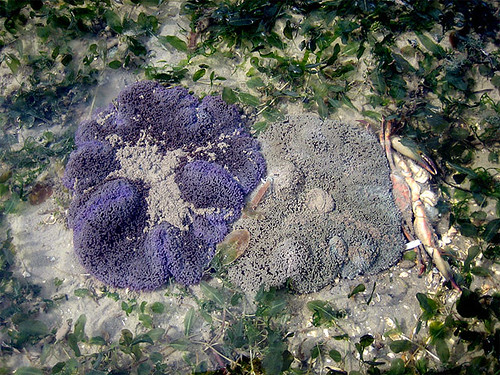
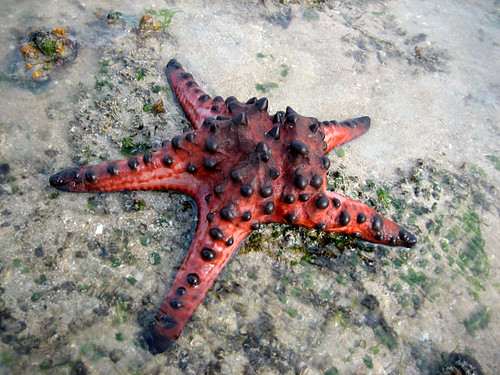
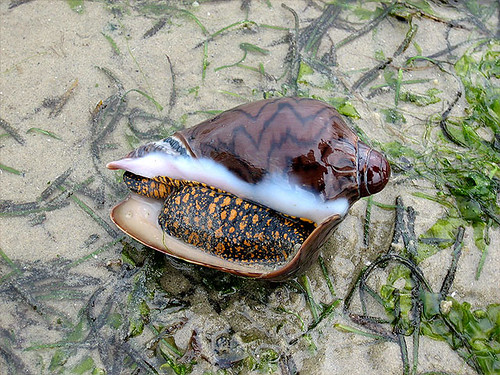
NF#2: On 18 January 2007, there was a public walk at Chek Jawa, and Adelle from Nparks informed the other regular guides that a lot of animals have died. We suspected that due to the heavy rainfall, Chek Jawa was flooded with freshwater, and it is known that most marine animals could not survive well in water with low salinity. Animals like the carpet anemone simply exploded from taking in too much freshwater, others like sea stars and sponges turned black and died, and many of the snails just died and decomposed into black liquid in their shells.


An exploded carpet anemone.


A dead knobbly seastar.


A decomposed noble volute.

NF#3: Kok Sheng from NUS is conducting a study on the mass mortality and recruitment of macrofauna for example like carpet anemones. This project also lays the foundation for the long-term monitoring and understanding of Chek Jawa.

More information at:
- 18th January
- Death Note from Chek Jawa
- First TeamSeagrass Field Orientation at Chek Jawa
- Chek Jawa Mortality and Recruitment Project

Chek Jawa Boardwalk

NF#1: The CJ boardwalk was constructed in about 18 months, but the impact on the rich seagrasses and sandflats was minimal. This is because the barge only brought in the construction material for the workers to do the piling during high tide, and when the tide got lower, it returned to deeper waters.

Interesting note: We started seeing oysters, mussels and barnacles on the pillars just weeks after they were placed! And we had seen healthy sea anemones growing just next to the pillars! The public walks were only suspended when the floods in January 2007 caused the massive mortality.


Question for Visitors: What material do you think the boardwalk is made of?

NF#2: While the boardwalk looks like it was made from wood, it was actually made from concrete and fibre glass! The mold used to make the boardwalk was made based on real wooden planks.


NF#3: The entire boardwalk is 1.1km long and has 2 sections - the coastal section (600m) and the mangrove section (500m).

Friday, August 17, 2007

Legend of Ubin and Pulau Sekudu

Naked Fact #1:
Three animals from Singapore -- a pig, an elephant and a frog -- had a challenge to see who would reach the shore of Johor first. Whichever animal that failed to reach the shore would be turned into rock. All three creatures had difficulties swimming the Straits and the frog turned into Pulau Sekudu, while both the pig and the elephant changed into one big rocky island - Ubin.

Naked Fact #2:
Pulau Ubin is originally bisected down the middle by the river Sungei Jelutong. However, due to prawn farming over the decades, the island has been joined together by the mud bunds across the river that form the prawn ponds. Perhaps that would explain why 2 animals form the bulk of Ubin.


Naked Fact #3:
The islet off Ubin that can be seen from Chek Jawa is named Pulau Sekudu which means Frog Island. There is a rock on Pulau Sekudu that resembles a frog. In fact, a smiley face has been painted on the "face" of the rock. However, it looks most like a frog from its side profile.


CARE Message:
Understand and respect the tides.
Pulau Sekudu, like much of the inter-tidal areas of Chek Jawa, is only accessible at low tide. However, the tides can be unpredictable and dangerous especially when the tide is rushing in. The water level can suddenly increase and you can be trapped on the fast-submerging islet before you know it. Accidents have been known to happen so it's always important to check tide tables before going out to shore areas. Safety first!

Jejawi Viewing tower

NF#1: The tower is 20m tall and allows visitors to get a good view of Chek Jawa and the surrounding areas. Due to it's height, the tower is also a great place to spot birds on nearby trees. This tower can take a maximum of 40 people.


NF#2: The Jejawi Tower is named after the Malayan Banyan (Ficus microcarpa) growing nearby that was as tall as the tower. The Malayan Banyan is a fig tree. As fig trees produce figs very regularly, they are able to provide regular food supplies for all kinds of animals such as birds and monkeys, unlike other forest trees that fruit perhaps once a year or even once every few years. In fact, such large fig trees play a critical role in providing food and shelter, and studies suggest the number of such fig trees limit the number of animals found in a forest.

Interesting Note: To connect visitors to figs, guides who understand Chinese can ask the visitors if they know the popular oldies "榕树下"(pronounced as Rong Shu Xia), which means "Under the Banyan Tree". Or has anyone eaten "无花果"(pronounced as Wu Hua Guo), which is also a fig. Do explain to the visitors that "无花果" actually do flower, just that the flowers are concealed within the fig. And what they are eating is not really the fruit, but a natural container for the flowers and seeds!

Too Much Information:

Figs are pollinated by tiny fig wasp that are mostly smaller than the head of a pin!

The female wasp somehow finds the correct fig tree in bloom, and sometimes, she must fly a long long way!

To get to the flowers, she squeezes through a tiny little hole in the fig. In the process she loses her wings and most of her antennae.

Usually, there are 3 types of flowers inside the fig:
1. Male flowers near the tiny hole
2. Female flowers with short styles
3. Female flowers with long styles

The male flowers are still immature without pollen. As the female wasp moves around in the fig, she transfers pollen she collected from her previous fig to the female flowers.

She will lay eggs in the female flowers with short styles. After laying the eggs, she dies.

After some time, the baby wasps hatch and feed on the plant tissue surrounding them. The males will hatch first. They are wingless but have strong mouth parts.

Meanwhile, the female flowers with the long styles develop seeds.

Once the male wasps become adults, they will seek out the female wasps and mate with them. After mating, the male wasps will chew and enlarge the tiny hole to create a wider tunnel so that the females can depart without losing their wings. The males usually die soon after they enlarged the tunnel.

As the females leave the fig, they pick up pollen from the male flowers that are now mature.

After they leave, the fig ripens and the walls become yummy to eat. Animals eat the fig and disperse the seeds.

Meanwhile, the brave little female wasp flies on to start the whole cycle then starts all over again.

Additional info on fig and fig wasp:
- The Fib Web
- The Last Stand of the Male Fig Wasp
- One Fig, One Wasp? Not Always!

Wednesday, August 15, 2007

House No. 1 - Chek Jawa Visitor Centre

NF#1: The Chek Jawa Visitor Centre is also call House No. 1, which is its postal address in Pulau Ubin. This unique building was built in the 1930s for Langdon Williams, the then Chief Surveyor, as a holiday retreat. It is made of masonry and emulates the style of an English cottage, first found in tea planters’ residences during the British colonial era. The building was awarded conservation status on 1 December 2003, and restoration work of the building was completed in 2006.


NF#2: House No. 1 is also the home to rare 2 species of rare bats! The fireplace, which is among the last few working ones left in Singapore, is the home to a colony of rare Pouched Tomb bats. The nearby water tower was retained as another rare species of Malayan False Vampire bats currently resides in it.

NF#3: There used to be another smaller outbuilding. Although newer than the main house, it had to be pulled down as it was no longer structurally sound. Some of its wall facades have been salvaged and incorporated into the toilet block.

Sunday, May 13, 2007

Fort Siloso: The Only Preserved British Coastal Fortification in Singapore

Three NAKED facts

NF#1: Built by the British in the 1880s to protect the western entrance to the Singapore harbour, Fort Siloso is the only preserved British coastal fortification in Singapore today. The name 'Siloso' supposedly comes from a Filipino word 'Seloso', which means a jealous person. The original name for Siloso Point was 'Sarang Rimau', or 'The Tiger's Lair', as it was said that tigers used to roam in the area.


Question for Visitors: Have you hear about the story that the Singapore Guns were facing the wrong way (south) when the Japanese attacked Singapore from the north during World War II?

NF#2: This is not true. The guns were not facing the wrong way, but the forts themselves were wrongly located for an attack from the north. The British had assumed that the defense in the north will be well-covered by Peninsular Malaysia. According to records, most of the forts, including Fort Siloso, took part in the battle.

NF#3: The fort complex is often incorrectly described as a tunnel complex, though in actual fact there are no real tunnels at the Fort, but underground chambers. There were stories that there are undersea tunnels that join Sentosa with Labrador Park. However, no one has been able to proof this so far. There are lots of natural caves along the coast of Sarang Rimau though.

Too Much Information:

The Fort was a POW Camp until the end of World War II. When the Japanese surrender in 1945, Fort Siloso returned to British occupancy, and in September that year, it was initially used by the Royal Navy.

The fort was opened to the public as the Singapore Gun Museum in 1975, and the buildings, underground complexes and gun emplacements both wartime and from the early days of Siloso are very well preserved, although some areas were changed to allow ease of access by tourists.