The coastal forest of Sarang Rimau at Siloso has a good number of Raffles' pitcher plants, which grow as mature vines that clamber and dangle from the larger trees. They are a carnivorous plant species and should be not confused with the plants known as Rafflesia, which are also vines but parasites with no leaves but very large flowers (and are not found in Singapore).
Pitcher plants have specialised leaves that form containers with fluid that is able to digest small animals from ants to even vertebrates like rats. The pitchers are an adaptation that allows the plant to survive in poor soils and other environments where nutrients are deficient and where most other plants cannot thrive.
The pitcher even has a 'lid' on top which is thought to help provide shade against rainwater that could cause the pitcher to overflow. Like most other Nepenthes species, N. rafflesiana produces two types of pitchers: upper and lower. The lower pitchers are produced on branches closer to the ground and are goblet-like, with two 'wings' that may serve to stabilise the pitcher on the ground. They are also much more colourful, with a marbled pattern, especially on the edge of the pitcher. Upper pitchers are slim with a tapered end and are produced on the higher vine-like portions of the plant.
Many small animals meet their doom in the pitchers, but there are also a few which can survive or even make a living from the pitcher plants. Some species of mosquitoes (not the disease-causing types) breed by laying eggs in the pitchers, and the larva feed on the remains of victims in the pitcher fluid. A species of crab spider can also be found which specialises on catching insect prey that approaches the pitchers.
Monday, May 21, 2007


Friday, May 18, 2007
Geology of Sentosa

NF#1: The cliffs of Sentosa appears to be wearing a nice pink layer of blush and this is thanks to the iron within the rocks which acts like make up for the cliffs which are actually made of sandstone. Iron reacts with the constant supply of fresh sea water and result in iron oxide which give it the pinkish reddish glow. It's better than Estee Lauder!

NF#2: The giant balls that look like bird shit littering the beach are actually not natural rocks! They are originally part of the sea wall that people built to prevent further erosion of the cliffs. So instead of eroding the cliff, the waves instead erode the sea wall that sacrifice themselves by standing in front of the cliff. Over time, the sea wall breaks down into pieces and then like any other normal boulders, it becomes smoothened and polished by the waves over decades and centuries.

NF#3: These natural toilets for boys and girls in case of urgent calls of nature are actually natural! They are not made by a kind hearted naked hermit crab to cater to your urgent needs. Instead, they were made by waves over hundreds of years, constantly hitting at the cliffs everyday. First they form little nooks then eventually become bigger caves! Over time, you might even find some have broken off from the cliff to form "stacks" like the Broken Soul Cliff 断魂崖 near Shangri-la!


NF#4: These strips of rocks are not the latest dykes or seawalls built by the government to prevent sea level rise. They are again naturally made coastal platforms. Imagine the beach is made of a giant kueh lapis of alternating hard and soft rocks. Eventually the waves will erode the soft rocks leaving the hard rocks that you are stepping on today!
Monday, May 14, 2007
Nudibranchs: Gems of the Sea
NF#1: 'Nudibranch' means 'naked gills'. The name comes from the flower-like gills found on the back of many nudibranchs. These nudibranchs use the gills to breathe.
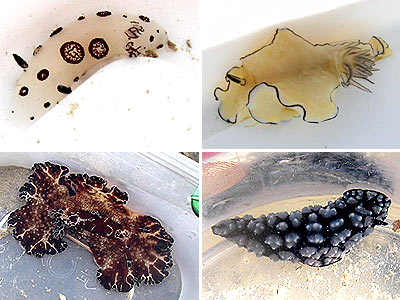
From top-left in clockwise direction, we have the polka dot nudibranch (Jorunna funebris), a marginated glossodoris nudibranch (Glossodoris atromarginata), a bohol nudibranch (Discodoris boholensis) and a pustolose phyllid nudibranch (Phyllidia pustolosa).
NF#2: Nudibranchs are related to snails. Little baby nudibranchs are born with shells, but they lose them when they become adults.
Thoughtful Question: Having a soft body without a shell makes the nudibranch very vulnerable to predators. How do you think they protect themselves?
Many nudibranch secretes chemicals when they are threatened. The chemicals may either make them very distasteful or even toxic!
That's why nudibranchs are not good for the aquarium! The chemicals they release may caused the other animals to be very stressed, or even die!
Some nudibranchs are also able to store the stinging cells of the hydriods or other cnidarians they feed on in their cerata.
Many nudibranchs are brightly coloured to warn the predators not to eat them, and some nudibranchs are also coloured to match their surrounding, which allow them to camouflage from the predators.
NF#3: Nudibranchs are carnivores, each species usually feed on a particular type of prey, which is usually something that can't move, like sponges, ascidians, hard corals, soft corals, sea anemones, zoanthids, peacock anemones, sea pens and eggs of other creatures. Some nudibranchs, such as the Gymnodoris nudibranch (Gymnodoris sp.) also feed on other slugs).
Here is a Gymnodoris rubropapulosa.

Too Much Information:
There are four sub-orders of nudibranchs - Doridina, Dendronotina, Arminina and Aeolidina.
Doridina is the biggest sub-order. You can identify dorids from the flower-like gills on its back. Dorids commonly seen on our southern shores include: Jorunna funebris, Glossodoris atromaginata, Gymnodoris rubropapulosa, Phyllidiella nigra and Phyllidiella pustulosa.
Dendronotids are charactierised by the two rows of branch-like structures called cerata on their backs. One of the dendronotids found on our southern shores is Bornella stellifer (see below).

Arminina is the smallest and most diversified suborder. The body is flattened and elongate with a mantle which extends into an oral veil. The gills are often along the side under under the mantle. One arminids seen on our southern shore is Armina semperi (see below).

Aeolids usually has thin bodies with projections (cerata) on their backs. One common aeolid we've seen on our southern shores is Pteraeolidia ianthina (see below).

How they "smell":
Many nudibranchs have two pairs of tentacles. One pair is near the mouth. The second pair is further back and called rhinophores. Rhinophores are believed to detect chemicals in the hunt for prey and mates.
Reproduction:
Nudibranchs are simultaneous hermaphrodites, meaning each slug has both male and female reproductive organs at the same time. They practice internal fertilisation, and do it side-by-side, facing opposite directions. Sometimes, one will act as the male partner and the other as the female. At other times, they may fertilise each other. After mating, they go their separate ways and each lays its egg mass. Nudibranchs usually die after laying their eggs. In some cases, the eggs are laid on or near a food source and the young ) hatch fully developed and commence feeding. In other cases, the young hatch and are carried in the current. They eventually settle unto a food source and continue developing into adults. The juvenile nudibranchs usually have shells, but lose them eventually when they turn into adult nudibranchs.
From top-left in clockwise direction, we have the polka dot nudibranch (Jorunna funebris), a marginated glossodoris nudibranch (Glossodoris atromarginata), a bohol nudibranch (Discodoris boholensis) and a pustolose phyllid nudibranch (Phyllidia pustolosa).
NF#2: Nudibranchs are related to snails. Little baby nudibranchs are born with shells, but they lose them when they become adults.
Thoughtful Question: Having a soft body without a shell makes the nudibranch very vulnerable to predators. How do you think they protect themselves?
Many nudibranch secretes chemicals when they are threatened. The chemicals may either make them very distasteful or even toxic!
That's why nudibranchs are not good for the aquarium! The chemicals they release may caused the other animals to be very stressed, or even die!
Some nudibranchs are also able to store the stinging cells of the hydriods or other cnidarians they feed on in their cerata.
Many nudibranchs are brightly coloured to warn the predators not to eat them, and some nudibranchs are also coloured to match their surrounding, which allow them to camouflage from the predators.
NF#3: Nudibranchs are carnivores, each species usually feed on a particular type of prey, which is usually something that can't move, like sponges, ascidians, hard corals, soft corals, sea anemones, zoanthids, peacock anemones, sea pens and eggs of other creatures. Some nudibranchs, such as the Gymnodoris nudibranch (Gymnodoris sp.) also feed on other slugs).
Here is a Gymnodoris rubropapulosa.
Too Much Information:
There are four sub-orders of nudibranchs - Doridina, Dendronotina, Arminina and Aeolidina.
Doridina is the biggest sub-order. You can identify dorids from the flower-like gills on its back. Dorids commonly seen on our southern shores include: Jorunna funebris, Glossodoris atromaginata, Gymnodoris rubropapulosa, Phyllidiella nigra and Phyllidiella pustulosa.
Dendronotids are charactierised by the two rows of branch-like structures called cerata on their backs. One of the dendronotids found on our southern shores is Bornella stellifer (see below).
Arminina is the smallest and most diversified suborder. The body is flattened and elongate with a mantle which extends into an oral veil. The gills are often along the side under under the mantle. One arminids seen on our southern shore is Armina semperi (see below).
Aeolids usually has thin bodies with projections (cerata) on their backs. One common aeolid we've seen on our southern shores is Pteraeolidia ianthina (see below).
How they "smell":
Many nudibranchs have two pairs of tentacles. One pair is near the mouth. The second pair is further back and called rhinophores. Rhinophores are believed to detect chemicals in the hunt for prey and mates.
Reproduction:
Nudibranchs are simultaneous hermaphrodites, meaning each slug has both male and female reproductive organs at the same time. They practice internal fertilisation, and do it side-by-side, facing opposite directions. Sometimes, one will act as the male partner and the other as the female. At other times, they may fertilise each other. After mating, they go their separate ways and each lays its egg mass. Nudibranchs usually die after laying their eggs. In some cases, the eggs are laid on or near a food source and the young ) hatch fully developed and commence feeding. In other cases, the young hatch and are carried in the current. They eventually settle unto a food source and continue developing into adults. The juvenile nudibranchs usually have shells, but lose them eventually when they turn into adult nudibranchs.
Copper-banded butterflyfish (Chaetodon rostratus)
Together with the anemone clownfish, this colourful fish is probably the leading flagship of coral reef life for many. Many juvenile specimens (1-2 inches long) can be found hiding amongst the seaweeds and seagrasses off Sentosa's shoreline.
Adults reach about 20 cm in length and are popular aquarium fishes in marine aquariums. Unfortunately they don't survive well in captivity as they require a constant and quality supply of live coral polyps to thrive, so it's not kind to either buy them from shops or catch them from the wild.
Their long beak-like mouths are made for plunging deep into coral growth to pluck out small polyps and other sessile creatures. The fish's laterally-compressed body also allows it to dash easily into narrow crevices. At the end of its dorsal fin, a large eye-epot may help to confuse would-be predators that the fish is actually some other larger animal or make them aim for the tail instead of the real head.

Adults reach about 20 cm in length and are popular aquarium fishes in marine aquariums. Unfortunately they don't survive well in captivity as they require a constant and quality supply of live coral polyps to thrive, so it's not kind to either buy them from shops or catch them from the wild.
Their long beak-like mouths are made for plunging deep into coral growth to pluck out small polyps and other sessile creatures. The fish's laterally-compressed body also allows it to dash easily into narrow crevices. At the end of its dorsal fin, a large eye-epot may help to confuse would-be predators that the fish is actually some other larger animal or make them aim for the tail instead of the real head.
Sunday, May 13, 2007
Leaf Slugs: Solar-Powered Suckers
Three NAKED facts
Question for visitor: Do you think this looks just like a leaf? That's why it is called a leaf slug!

NF#1: Leaf slugs belong to a bigger group of animials called the sap-sucking slugs. Instead of breaking off bits of sea weed, munching and eating them, leaf slugs pierce a hole in the algae and suck out the cell contents.
NF#2: Leaf slugs are able to keep keep the algae's chloroplasts (the part that contains chlorophyll), which continue to photosynthesise inside the slug and provide the slug with additional nutrients. That's why they look so green! But don't you agree that being green allow them to blend into so nicely with the surrounding seaweed, and that predators will have a hard time finding them?
Corny Joke: If only we can do that as well, we just need to eat some vegetables and then go sun-tanning to get the nutrients we need! Problem is everyone will turn green though... Quite eerie...
NF#3: Leaf slugs are basically snails without shells. They may look soft and defenseless, but they are NOT! The white specks in its colour pattern are in fact what we call glands. These glands can secrete a milky chemical when irritated, which can make it very distasteful for its predators. It is believed they recycle the chemicals from the food they eat.
Too Much information:
Leaf slugs are not nudibranchs! They are from the order Sacoglossa, which nudibranchs are from the order Nudibranchia. Both, however, are mollusks from the same class, Gastropoda. The leaf slug we usually see on our shores is Elysia ornata (see below).

Reproduction:
Elysia, as with all slugs, are hermaphrodites. They have both male and female reproductive organs which are located on the right side of the head.
Hints for guides:
Leaf slugs are seasonally abundant on our shores. They usually come and go with the hairy green seaweed, bryopsis, which they feed on. So if you see lots of hairy seaweeds, keep your eyes open.
Here's another species of Elysia which we see sometimes.

Question for visitor: Do you think this looks just like a leaf? That's why it is called a leaf slug!
NF#1: Leaf slugs belong to a bigger group of animials called the sap-sucking slugs. Instead of breaking off bits of sea weed, munching and eating them, leaf slugs pierce a hole in the algae and suck out the cell contents.
NF#2: Leaf slugs are able to keep keep the algae's chloroplasts (the part that contains chlorophyll), which continue to photosynthesise inside the slug and provide the slug with additional nutrients. That's why they look so green! But don't you agree that being green allow them to blend into so nicely with the surrounding seaweed, and that predators will have a hard time finding them?
Corny Joke: If only we can do that as well, we just need to eat some vegetables and then go sun-tanning to get the nutrients we need! Problem is everyone will turn green though... Quite eerie...
NF#3: Leaf slugs are basically snails without shells. They may look soft and defenseless, but they are NOT! The white specks in its colour pattern are in fact what we call glands. These glands can secrete a milky chemical when irritated, which can make it very distasteful for its predators. It is believed they recycle the chemicals from the food they eat.
Too Much information:
Leaf slugs are not nudibranchs! They are from the order Sacoglossa, which nudibranchs are from the order Nudibranchia. Both, however, are mollusks from the same class, Gastropoda. The leaf slug we usually see on our shores is Elysia ornata (see below).
Reproduction:
Elysia, as with all slugs, are hermaphrodites. They have both male and female reproductive organs which are located on the right side of the head.
Hints for guides:
Leaf slugs are seasonally abundant on our shores. They usually come and go with the hairy green seaweed, bryopsis, which they feed on. So if you see lots of hairy seaweeds, keep your eyes open.
Here's another species of Elysia which we see sometimes.
Angsana: The Breakable Tree
NF#1: The angsana tree (Pterocarpus indicus) was introduced into Singapore in the early 19th century. It is native to the southern part of the east coast of Peninsular Malaysia. The tree was introduced to provide shade as it is quick growing and easily transplanted.
NF#2: However, mature trees are known to have a weak structure, and break easily, especially during stormy weathers. Being a roadside tree, it is thus a potential hazard for vehicles and nearby buidlings. This is also probably the reason why this tree looks like this now.

Joke: Ahem, this tree always remainds me of some people I know - those who appear strong and hardly outside, but turn out to be weaklings.
NF#3: Angsana wood is said to be the best fine-furniture wood in Malaysia. It is used to make tables, chairs, cabinets, and decorative items.
Too Much information
You will be quite lucky if you can see the flowers, as they usually last for only one day. The flowers are small, yellow and faintly fragrant. They grow in large bunches 15 to 30 cm long.
NF#2: However, mature trees are known to have a weak structure, and break easily, especially during stormy weathers. Being a roadside tree, it is thus a potential hazard for vehicles and nearby buidlings. This is also probably the reason why this tree looks like this now.
Joke: Ahem, this tree always remainds me of some people I know - those who appear strong and hardly outside, but turn out to be weaklings.
NF#3: Angsana wood is said to be the best fine-furniture wood in Malaysia. It is used to make tables, chairs, cabinets, and decorative items.
Too Much information
You will be quite lucky if you can see the flowers, as they usually last for only one day. The flowers are small, yellow and faintly fragrant. They grow in large bunches 15 to 30 cm long.
Fort Siloso: The Only Preserved British Coastal Fortification in Singapore
Three NAKED facts
NF#1: Built by the British in the 1880s to protect the western entrance to the Singapore harbour, Fort Siloso is the only preserved British coastal fortification in Singapore today. The name 'Siloso' supposedly comes from a Filipino word 'Seloso', which means a jealous person. The original name for Siloso Point was 'Sarang Rimau', or 'The Tiger's Lair', as it was said that tigers used to roam in the area.

Question for Visitors: Have you hear about the story that the Singapore Guns were facing the wrong way (south) when the Japanese attacked Singapore from the north during World War II?
NF#2: This is not true. The guns were not facing the wrong way, but the forts themselves were wrongly located for an attack from the north. The British had assumed that the defense in the north will be well-covered by Peninsular Malaysia. According to records, most of the forts, including Fort Siloso, took part in the battle.
NF#3: The fort complex is often incorrectly described as a tunnel complex, though in actual fact there are no real tunnels at the Fort, but underground chambers. There were stories that there are undersea tunnels that join Sentosa with Labrador Park. However, no one has been able to proof this so far. There are lots of natural caves along the coast of Sarang Rimau though.
Too Much Information:
The Fort was a POW Camp until the end of World War II. When the Japanese surrender in 1945, Fort Siloso returned to British occupancy, and in September that year, it was initially used by the Royal Navy.
The fort was opened to the public as the Singapore Gun Museum in 1975, and the buildings, underground complexes and gun emplacements both wartime and from the early days of Siloso are very well preserved, although some areas were changed to allow ease of access by tourists.
NF#1: Built by the British in the 1880s to protect the western entrance to the Singapore harbour, Fort Siloso is the only preserved British coastal fortification in Singapore today. The name 'Siloso' supposedly comes from a Filipino word 'Seloso', which means a jealous person. The original name for Siloso Point was 'Sarang Rimau', or 'The Tiger's Lair', as it was said that tigers used to roam in the area.
Question for Visitors: Have you hear about the story that the Singapore Guns were facing the wrong way (south) when the Japanese attacked Singapore from the north during World War II?
NF#2: This is not true. The guns were not facing the wrong way, but the forts themselves were wrongly located for an attack from the north. The British had assumed that the defense in the north will be well-covered by Peninsular Malaysia. According to records, most of the forts, including Fort Siloso, took part in the battle.
NF#3: The fort complex is often incorrectly described as a tunnel complex, though in actual fact there are no real tunnels at the Fort, but underground chambers. There were stories that there are undersea tunnels that join Sentosa with Labrador Park. However, no one has been able to proof this so far. There are lots of natural caves along the coast of Sarang Rimau though.
Too Much Information:
The Fort was a POW Camp until the end of World War II. When the Japanese surrender in 1945, Fort Siloso returned to British occupancy, and in September that year, it was initially used by the Royal Navy.
The fort was opened to the public as the Singapore Gun Museum in 1975, and the buildings, underground complexes and gun emplacements both wartime and from the early days of Siloso are very well preserved, although some areas were changed to allow ease of access by tourists.
Subscribe to:
Posts (Atom)
